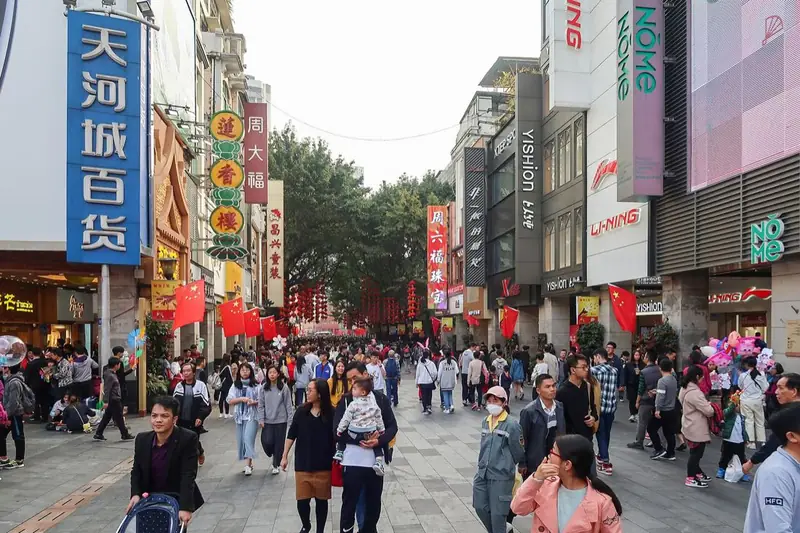
Shangxiajiu vs Beijing Road:
Honestly? Go to Yongqingfang
Guangzhou's two famous pedestrian streets are both free, both historic, and both more shopping than eating. Shangxiajiu has the better architecture — about 1.2km of street lined mostly with qilou arcades — but its mid-street stalls sell squid skewers and Wuhan duck neck, which is not Guangzhou food; the real destinations are its side streets (Baohua Road, Shibafu, Longjin Road). Beijing Road has the better history — glass floor panels exposing eleven layers of road surface, Tang dynasty at the bottom to the Republican era at the top — but the street above the glass is a generic retail corridor. The honest answer: give Beijing Road twenty minutes for the archaeology, and spend the saved evening at Yongqingfang, five minutes from Shangxiajiu and better than both.
Two streets, one honest ranking
Shangxiajiu 上下九
Guangzhou's first commercial pedestrian street (1995) and one of the first in China, with hundreds of shops under qilou colonnades. Increasingly commercialised and repetitive on the main drag — treat it as the corridor and Baohua Rd, Shibafu and Longjin Rd as the destination. Nanxin's double-skin milk at 47 Dishifu Rd (~¥15) is the one mandatory stop. Full verdict →
Beijing Road 北京路
A street in continuous commercial use for two millennia, proven by the excavated road surfaces under glass at your feet — Tang under Southern Han under Song–Yuan under Ming under Republic, eleven layers in all. That is genuinely worth seeing. The shops above are not. The good food is one block east on Huifu East Road and Wenming Road. Full verdict →
Yongqingfang 永庆坊
The restored Enning Road quarter five minutes west of Shangxiajiu: granite lanes, the Cantonese Opera Art Museum (free), Bruce Lee's ancestral home, the Moon Bridge once it is lit after dark, and food priced for locals. Arrive mid-afternoon, stay through the lights. Full verdict →
Questions people actually search
Is Shangxiajiu worth visiting?
For the qilou arcade architecture and the side-street food, yes — briefly. The pedestrian drag itself is commercialised and the famous snack stalls mostly sell pan-China street food rather than anything Cantonese. Walk it once end to end, eat on Baohua Road or at Nanxin, then continue five minutes to Yongqingfang.
What is under the glass on Beijing Road?
Excavated road surfaces from more than a thousand years of the same street: eleven layers found in 2002, from Tang-dynasty paving at the bottom through Southern Han, Song–Yuan and Ming to the Republican-era road at the top, all left in situ under walkable glass panels. It is the fastest history lesson in Guangzhou and it costs nothing — Line 6 to Beijing Lu.
Which is better for food, Shangxiajiu or Beijing Road?
Neither headline street is the answer. Off Shangxiajiu: Nanxin (double-skin milk, ~¥15) and the Baohua Road shops including Shunji Ice Room. Off Beijing Road: Huifu East Road's cheung fun and claypot rice, and Wenming Road's dessert-and-congee corridor two blocks south — the best cheap eating street in the city.
Are Guangzhou's pedestrian streets open at night?
Both are public streets with no gate, so you can walk them in the evening; the shops keep their own times, which change, so check a shop's current listing on Google Maps if one matters. The qilou arcades of Shangxiajiu photograph best after dark. But the better evening is Yongqingfang, where the Moon Bridge is lit after dusk and the crowds are a fraction of either famous street.
- Beijing Road ancient road site: eleven layers, Tang to Republic, found 2002 — Wikipedia (zh)
- Shangxiajiu pedestrian street: opened 1995, about 1,218m, qilou arcades — Wikipedia (zh)
- Guangzhou's first commercial pedestrian street — Sina Finance
- Getting to Yongqingfang: Huangsha and Changshou Lu stations — Bendibao
Spotted something out of date? See how we check and correct facts.