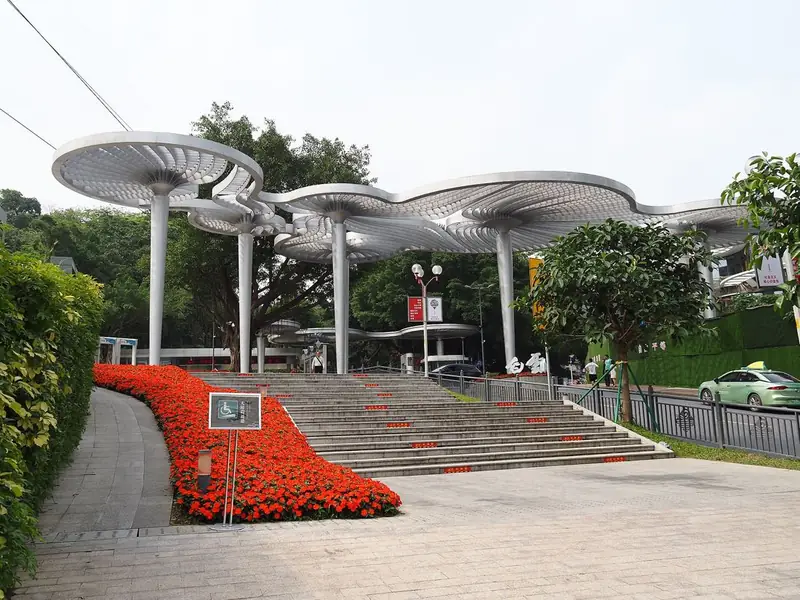
Is Baiyun Mountain Worth It? The ¥5 Mountain, Decided (2026)
A 382m ridge inside the city limits, ¥5 to walk in, and used by tens of thousands of residents as a gym — the locals climb it at first light and again after dinner. And it only got a south-gate metro station in December 2024.
¥5 (about $0.75) gets you into a forested mountain park in the middle of a 19-million-person city, and another ¥5 gets you onto the 382m Moxing Ridge summit. The cable car is ¥25 up and ¥20 down (¥13 and ¥10 half fare), and if you ride it you do not need a separate gate ticket; Yuntai Garden is ¥10 extra. What makes it genuinely unusual is how the city uses it: residents climb at first light and again after dinner, and the view is completely different at each end of the day. Go on a weekday between October and December, and at a weekend either arrive early or walk instead of queuing.
What Baiyun Mountain actually costs
The pricing is modular and the numbers are so low that the usual value question does not apply. The only real decision is whether you ride the cable car or walk, and that is a queue decision rather than a money one.
| What | Price | What you get | Verdict |
|---|---|---|---|
| Park entry | ¥5 (~$0.75) | The scenic area itself — trails, forest, the fitness route, the lower viewpoints. | WORTH IT |
| Moxing Ridge summit | +¥5 | The 382m top, and the reason the walk-up crowd is here. Separate small ticket on top of entry. | WORTH IT |
| Cable car up | ¥25 (~$3.70; half fare ¥13) | Saves roughly an hour of climbing from the south side, and covers your entry — riders need no separate gate ticket. Weekend queues routinely exceed an hour, which cancels the saving entirely. | DEPENDS |
| Cable car down | ¥20 (half fare ¥10) | Easier call than the upward leg — you are tired, the queue is usually shorter, and the descent is harder on knees than it looks. | WORTH IT |
| Yuntai Garden | ¥10 | Formal botanical garden at the south gate, immediately by the new Line 11 exit. Separate ticket, separate site. | DEPENDS |
Cable car fares are the standard set by Guangzhou's price regulator in May 2025: half fare covers children 1.3–1.5m and over-65s, and children up to 1.3m or aged 6 and under ride free. The cable car keeps shorter hours than the mountain paths, so the first-light and after-dark climbs are walking visits — the Directions link opens Google Maps with today's times for both.
Line 11 put the south gate on the network in December 2024
Almost every English page still routes you to Line 3 and Yongtai on the north side, or tells you to take a taxi. That advice is a generation out of date.
The Line 11 loop opened on 28 December 2024 and it serves Yuntai Garden, Exit C2 — which puts you at the south gate cluster, the cable car base station and the botanical garden entrance in one exit. For most visitors staying in Yuexiu, Liwan or Tianhe this is now the obvious approach, and Line 11 being a loop means you rarely need more than one interchange to reach it.
The northern approach via Line 3 → Yongtai, then a short bus or walk to the western gates, still exists and is the better start if you want the long walk rather than the cable car. It puts you at the quieter end of the ridge, where the paths are less commercial and the crowd thins out fast.
There is a third option worth knowing about: the stepped fitness route up from the south side. Locals use it as a training climb, it is free of queues by definition, and it takes most reasonably fit people 45–70 minutes. If you arrive on a Saturday and see the cable car line snaking out of the plaza, this is the answer — you will reach the top before the people who queued.
Google Maps does not work in mainland China. It is blocked, and even over a VPN the base map is shifted by China's mandatory GCJ-02 coordinate offset and the points of interest are years stale. The Directions button on this page is for planning from home. On the ground use Amap (高德地图), which has a real English mode — or just use the metro line, station and exit number printed on every page here, which is what locals use.
Baiyun Mountain, hour by hour
The early-and-late rhythm is the whole point of this mountain, and the two best hours on it are the two nobody plans for. Gate and cable-car times change — the Directions link has today's.
★ The best hour of the day. Clear light, birds, tai chi groups on the terraces, and you will meet more locals than tourists all the way up.
Rather book it?City highlights tour with dim sum lunch on GetYourGuide ↗
October to December, and one enormous exception
Baiyun Mountain is a weather-dependent sight in a city with a hard weather verdict, and one festival transforms it completely.
Mid-October to early December is the window: rain falls from 365mm in June to 33–67mm, humidity drops to about 62%, and the temperature sits at 20–29°C. That is when a 382m climb is a pleasure rather than an ordeal. From April to September the same walk is a genuinely hard 32–33°C at 75–79% humidity, which is why locals climb at first light in summer.
The exception is Double Ninth, the ninth day of the ninth lunar month, when climbing high ground is a Chinese custom with two thousand years behind it. Baiyun Mountain is where Guangzhou does it, and it is not a token observance — people climb through the night, and the crowd is measured in the hundreds of thousands. If you want to see a genuine mass tradition rather than a performance for visitors, this is one of the great ones. If you want a quiet walk, pick literally any other day.
Guangzhou's weather verdict is unusually clean: mid-October to early December. Rain collapses from 365mm in June to 33–67mm, humidity drops to about 62%, and it sits at 20–29°C. The problem is that those same weeks hold National Day (1–7 October) and the autumn Canton Fair (15 October – 4 November 2026), when hotel rates run 2–4× normal. Late November to early December is the actual sweet spot — same weather, no fair, low prices. No competing guide makes that call.
Is Baiyun Mountain for you?
Baiyun Mountain, practically
Guided hikes and the tours that include it
You do not need to book anything to climb a ¥5 mountain, and we would not pretend otherwise. What is worth paying for is a guide who knows the trail network — the mountain has several distinct routes and the signage assumes you read Chinese.
Baiyun Mountain questions
How much does Baiyun Mountain cost?
¥5 to enter, about $0.75, plus another ¥5 for the Moxing Ridge summit. The cable car is ¥25 up and ¥20 down, and Yuntai Garden at the south gate is a separate ¥10. A complete visit on foot costs ¥10 — it is the cheapest half-day in Guangzhou.
How much is the Baiyun Mountain cable car?
¥25 one way up and ¥20 one way down for an adult, so ¥45 for the round trip. Half fare — ¥13 up, ¥10 down — applies to children between 1.3m and 1.5m and to over-65s, and children up to 1.3m or aged 6 and under ride free. Those are the standard fares Guangzhou's price regulator set in May 2025, and if you ride the cable car you do not need to buy the ¥5 gate ticket as well.
What are Baiyun Mountain's opening hours?
Times for the gates and the cable car change, so we do not print them — the Directions link opens Google Maps with today's. What does not change: locals climb from first light and again after dinner, the best hours on the mountain are around 07:00 and 17:00, and at weekends the cable-car queue builds through the morning, so arrive early if you want to ride rather than walk.
How do you get to Baiyun Mountain by metro?
Line 11 to Yuntai Garden, Exit C2, for the south gate, the cable car base and the botanical garden — this opened on 28 December 2024 and most guides have not caught up. For the quieter north-western approach, take Line 3 to Yongtai and continue by bus or on foot.
Is the cable car worth it?
Downhill, usually yes at ¥20. Uphill it depends entirely on the day: weekend queues regularly run over an hour, which is longer than the 45–70 minute walk up the stepped fitness route it was meant to save you. Arrive early or plan to walk.
How long does it take to climb?
The stepped fitness route takes most reasonably fit people 45 to 70 minutes to the summit area, and 40 to 60 minutes back down. Add time at the top and a complete visit runs three to five hours; cable car both ways compresses it to about two.
When is the best time of year?
Mid-October to early December, when rain drops to 33–67mm a month and humidity falls to around 62%. Avoid Double Ninth unless crowds are what you came for — people climb through the night and the mountain draws hundreds of thousands for the traditional height-climbing custom.
Is it worth it if I only have one day in Guangzhou?
Only if you start at first light with the locals and treat it as the pre-breakfast activity. On a single day the museums and Xiguan give you more of the city, but the mountain is the one thing that works before the rest of the city gets going, which makes it a bonus rather than a trade-off.
- Baiyun Mountain cable car fares from May 2025: ¥25 up, ¥20 down — Guangzhou Daily (Dayoo)
- Baiyun Mountain gate, Moxing Ridge and Yuntai Garden ticket prices — Guangzhou Bendibao
- Yuntai Garden station, Line 11, opened 28 December 2024 — Wikipedia (zh)
- Line 11 opens: Yuntai Garden Exit C2 for the garden and cable car — Guangzhou Baiyun news
Spotted something out of date? See how we check and correct facts.